


SnowPro Advanced DAA-C01 Dumps | Updated Dec 31, 2025 - ValidDumps
Master 2025 Latest The Questions SnowPro Advanced and Pass DAA-C01 Real Exam!
NEW QUESTION # 83
You have a table 'CUSTOMER LOCATIONS with customer IDs and their geographical locations in WGS 84 format stored in 'LATITUDE' (FLOAT) and 'LONGITUDE' (FLOAT) columns. You need to create a new table 'CUSTOMER GEOGRAPHY' with a 'LOCATION' column of GEOGRAPHY type derived from these latitude and longitude values. Which of the following statements, used individually or in combination, are necessary and correct to accomplish this?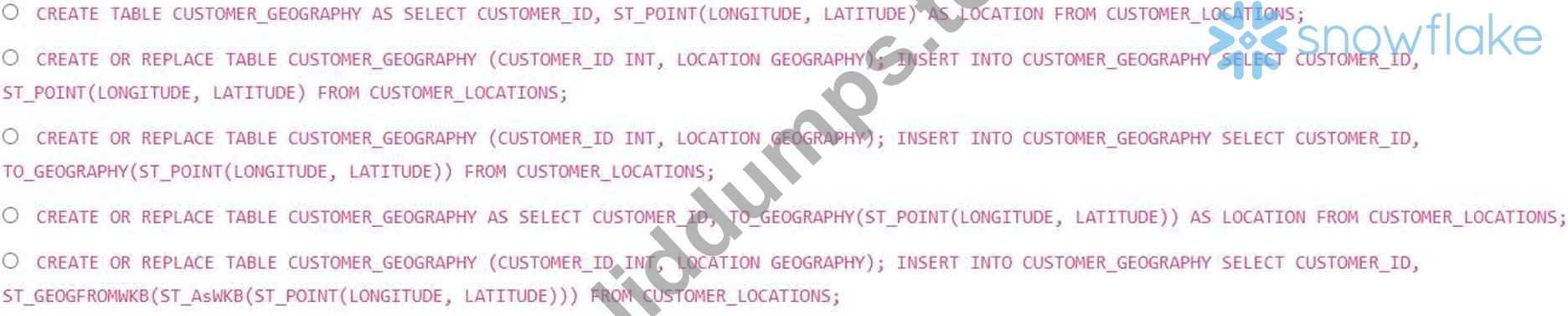
- A. Option B
- B. Option D
- C. Option C
- D. Option E
- E. Option A
Answer: B
Explanation:
Option D correctly creates the table using a 'CREATE TABLE AS SELECT (CTAS) statement and uses TO LATITUDE))' to convert the latitude and longitude values into a GEOGRAPHY object. This is a concise and efficient way to create the new table with the desired GEOGRAPHY column.
NEW QUESTION # 84
You have a Snowsight dashboard that visualizes daily sales trends. Business users complain that the dashboard takes too long to load, especially when filtering by specific product categories. The underlying data resides in a large table partitioned by 'sale date'. Which of the following actions would BEST improve the dashboard's performance, assuming the filters are appropriately configured in the dashboard and the virtual warehouse size is already appropriately sized?
- A. Implement result caching by setting = TRUE at the session level.
- B. Convert the dashboard into a Streamlit application for improved rendering performance.
- C. Create a materialized view that pre-aggregates the data used by the dashboard, including the dimensions used in the filters.
- D. Increase the virtual warehouse size used by Snowsight.
- E. Use query acceleration on the base table to improve the speed of underlying queries when the filter are being applied by users.
Answer: C
Explanation:
Creating a materialized view pre-aggregates the data, significantly reducing query execution time. The materialized view stores the result of a query, and Snowflake automatically refreshes it when the underlying data changes. Since the product categories are used as filters, pre- aggregating along these dimensions directly addresses the slow loading times. Increasing warehouse size (B) only helps if the compute resources are a bottleneck, which might not be the primary issue. Converting to Streamlit (C) changes the presentation layer but doesn't inherently improve data retrieval. Query Acceleration (D) can help, but only if it properly sized and configured. Session level caching (E) might only benefit the same user, but if multiple users are accessing the same dashboard, the best way would be through pre-aggregated results in a materialized view.
NEW QUESTION # 85
You have a Snowflake table named 'customer transactionS with columns: 'customer id', 'transaction date', 'transaction amount, and product_categorV. You need to identify customers who have made purchases in more than three different product categories within the last 30 days. Which of the following Snowflake SQL queries is the MOST efficient and accurate way to achieve this, considering the large size of the table?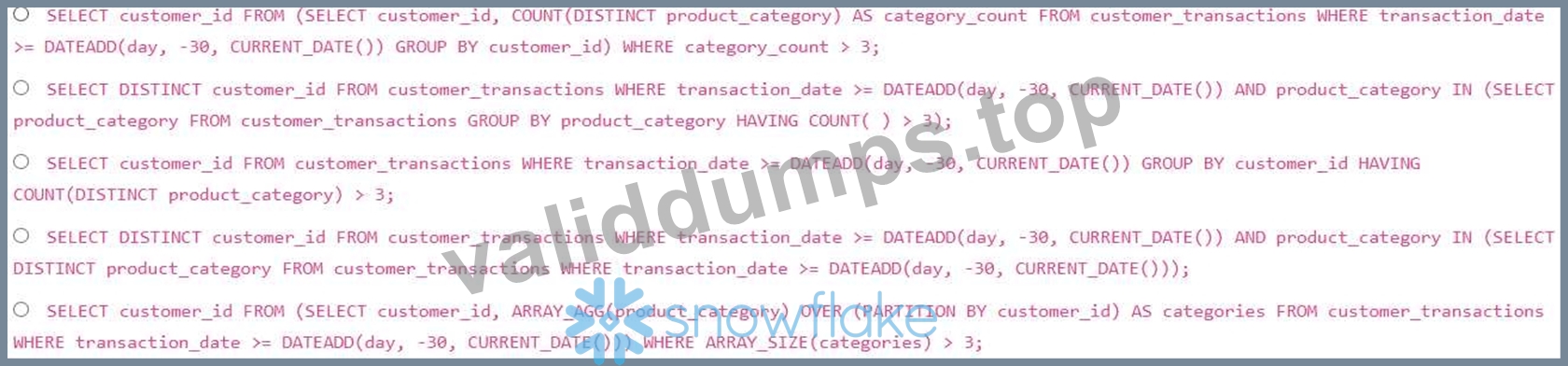
- A. Option B
- B. Option D
- C. Option E
- D. Option A
- E. Option C
Answer: E
Explanation:
Option C is the most efficient. It directly groups by 'customer_id' and uses the 'HAVING' clause to filter customers who have purchased from more than three distinct product categories within the specified date range. Option A is functionally correct but less concise. Option B uses an inefficient subquery. Option D returns all customer IDs who purchased from any product category within the timeframe. Option E attempts to use window functions and ARRAY AGG, which is unnecessarily complex and less performant for this task.
NEW QUESTION # 86
A financial analyst is using Snowflake to forecast stock prices based on historical data'. They have a table named 'STOCK PRICES with columns 'TRADE DATE (DATE) and 'CLOSING PRICE (NUMBER). They want to implement a custom moving average calculation using window functions to smooth out short-term fluctuations and identify trends. Specifically, they need to calculate a 7-day weighted moving average, where the most recent day has the highest weight and the weights decrease linearly. Which SQL statement correctly implements this weighted moving average calculation?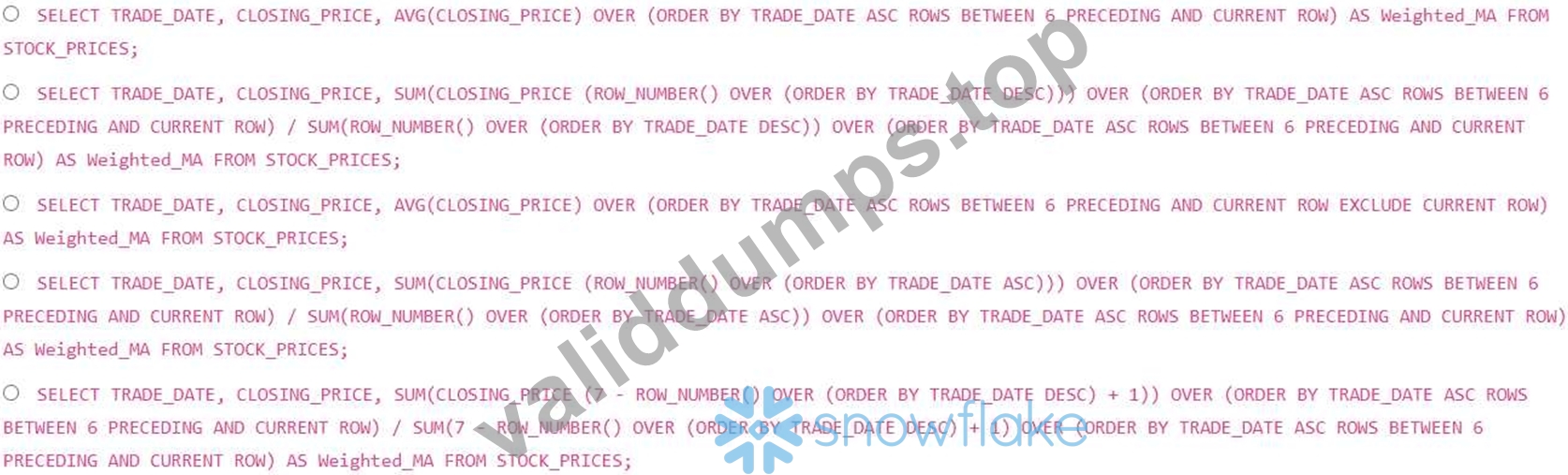
- A. Option B
- B. Option C
- C. Option D
- D. Option A
- E. Option E
Answer: E
Explanation:
Option E is the correct answer because it accurately calculates the 7-day weighted moving average with linearly decreasing weights. It assigns weights from 7 (most recent) down to 1 (oldest) within the 7-day window. The weight calculation '(7 - ROW_NUMBER() OVER (ORDER BY TRADE DATE DESC) + 1)' ensures the most recent date has a weight of 7, and the weights decrease linearly to 1. The sum of the weighted closing prices is then divided by the sum of the weights to get the weighted average. Other options are incorrect because they either calculate a simple moving average, apply incorrect weights, or have syntactic errors. Option B and D's row_number() is ordered ascending, resulting in the oldest data point having the highest weight.
NEW QUESTION # 87
How does using Snowsight's data loading capabilities impact the overall data preparation process?
- A. Streamlines data loading, reducing preparation time
- B. Doesn't support batch data loading
- C. Increases data transformation complexities
- D. Limits data loading to specific file formats
Answer: A
Explanation:
Snowsight's data loading capabilities streamline the process, reducing preparation time by facilitating efficient data loading.
NEW QUESTION # 88
What role does operationalizing data play in maintaining reports and dashboards for business requirements?
- A. It restricts data updates, affecting dashboard accuracy.
- B. Operationalizing data complicates dashboard management.
- C. Operationalizing data ensures consistent and efficient usage.
- D. It limits the usability of reports by narrowing down access.
Answer: C
Explanation:
Operationalizing data ensures consistent and efficient usage of reports and dashboards.
NEW QUESTION # 89
You are tasked with cleaning and transforming a dataset containing customer information in Snowflake. This dataset includes columns such as 'CUSTOMER ID, 'NAME', 'EMAIL', 'PHONE NUMBER', and 'ADDRESS'. Your goal is to implement several data quality rules: 1) Ensure all phone numbers are in a consistent '+1-XXX-XXX-XXXX' format (where X is a digit). 2) Remove any leading or trailing whitespace from the 'NAME and 'ADDRESS' columns. 3) Replace invalid email addresses (identified by failing a specific regex pattern) with NULL. Which combination of Snowflake SQL statements would efficiently and accurately address these requirements?
- A.

- B.

- C.

- D.

- E.

Answer: B
Explanation:
Option D correctly addresses all requirements by performing all transformations within a single CREATE OR REPLACE TABLE statement. This ensures atomicity and avoids multiple update operations. It correctly trims NAME and ADDRESS, replaces invalid emails with NULL, and formats phone numbers if they have exactly 10 digits after removing non-numeric characters, otherwise assigning NULL. The correct option must format phone number as well as replace with NULL, while not replacing with NULL would mean keep original. Option E keeps original value not NULL, if phone number doesn't match criteria.
NEW QUESTION # 90
In Snowflake, what factors determine the effectiveness of using materialized views for query optimization?
- A. Query result caching capabilities
- B. Frequency of data updates and refresh requirements
- C. Compatibility with specific BI tools only
- D. Limitations in accessing historical data
Answer: A,B
Explanation:
Materialized views' effectiveness depends on factors like data update frequency and query result caching, impacting query optimization based on the nature of data updates and caching capabilities.
NEW QUESTION # 91
How do Snowsight dashboards facilitate the presentation of data for business use analyses?
- A. Snowsight dashboards are exclusively text-based, limiting analyses.
- B. Snowsight doesn't support visual data representation.
- C. They enable diverse data representation for effective analyses.
- D. Snowsight limits data representation options, hindering analyses.
Answer: C
Explanation:
Snowsight dashboards enable diverse data representation for effective analyses in business use cases.
NEW QUESTION # 92
You are tasked with performing a descriptive analysis of website traffic data stored in a Snowflake table named 'website traffic'. The table includes columns such as 'session_id', 'user id', 'page_url' , 'timestamp' , and 'device_type'. Which of the following SQL queries would be MOST efficient and accurate for calculating the daily active users (DAU) and their device distribution?
- A.

- B.

- C.

- D.

- E.

Answer: D
Explanation:
Option E is the most efficient and accurate. It correctly uses user_id)' to calculate DALI, groups by date and device type, and orders the results. Option A is missing aggregation to calculate DAU per device. Option B uses APPROX COUNT DISTINCT which is less accurate. Option C counts all user_id entries, not distinct users. Option D includes user_id in the GROUP BY, causing incorrect DAU calculation, and calculates total users incorrectly.
NEW QUESTION # 93
You have a Snowflake table containing order data'. You need to calculate the shipping cost for each order based on the order amount and the destination country. You decide to use a Java UDF for this calculation, as the logic is complex and involves external APIs (simulated here). The UDF should take the order amount (FLOAT) and destination country (VARCHAR) as input and return the calculated shipping cost (FLOAT). The Java code requires external JAR files to be imported. Which of the following options correctly defines and calls the Java UDF in Snowflake, assuming the necessary JAR file has been uploaded to a stage named 'my_stage'?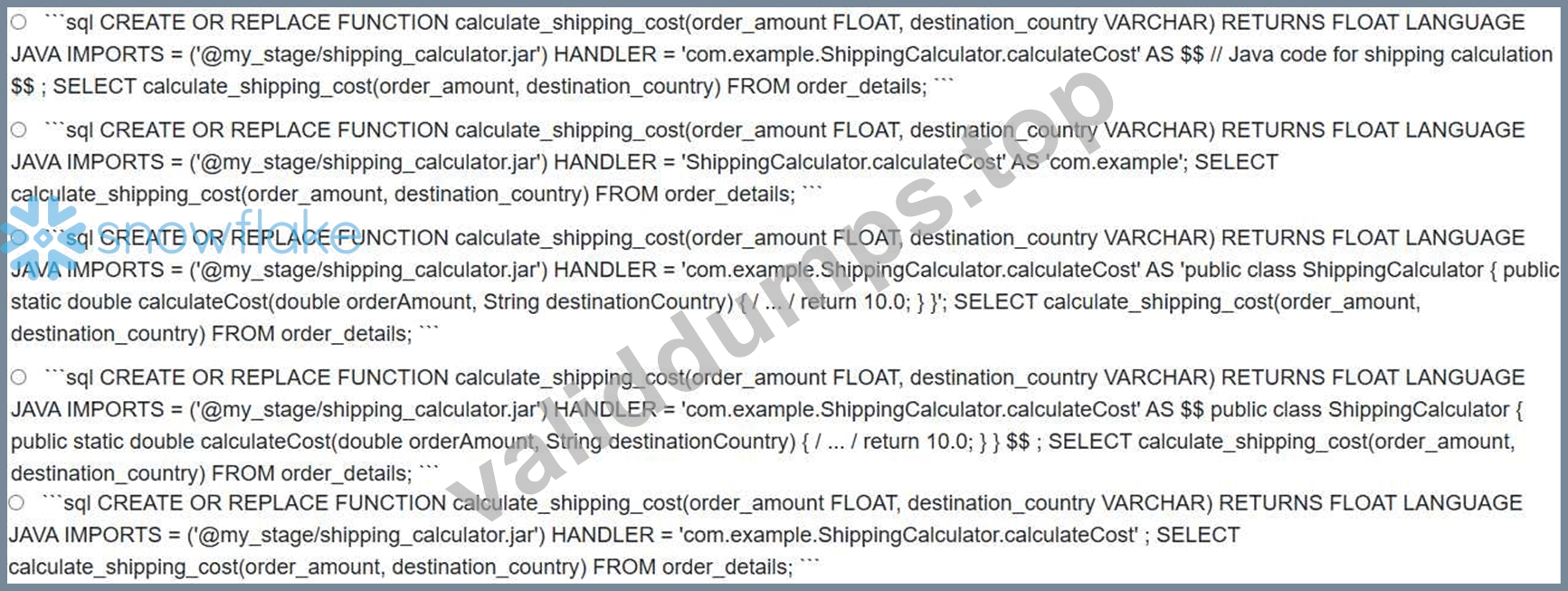
- A. Option B
- B. Option C
- C. Option D
- D. Option A
- E. Option E
Answer: E
Explanation:
Option E is the most correct because the function definition does not require the definition of the class 'com.example.ShippingCalculator' within the function body. Since the jar file is defined within the imports section, snowflake does not need the explicit definition. Option A, C, and D requires the function and class definition which is already defined in the jar, and defining it again will lead to conflicts. Option B doesn't correctly define the class. All the rest of the options either try to define the Java code inline (which is incorrect when using IMPORTS) or have syntax errors in the UDF definition.
NEW QUESTION # 94
A financial services company is migrating its transaction data from various sources, including mainframe systems, REST APIs, and flat files, into Snowflake. They want to leverage Snowflake's features for continuous data ingestion and transformation. Which combination of Snowflake features and external tools would provide the MOST scalable and efficient solution for this scenario?
- A. Snowflake Tasks scheduled to periodically load data from external stages containing mainframe extracts, combined with materialized views for near real-time transformations.
- B. Using external tables with direct access to the source systems, combined with stored procedures to transform the data on-read.
- C. Snowpipe with REST API integration using AWS Lambda functions triggering file loads from S3, and a Snowpark pipeline to transform mainframe data after initial staging.
- D. Snowpipe with auto-ingest enabled for flat files, Kafka Connector for REST API data streamed into Snowflake, and a custom Python script running as a Snowflake external function to process mainframe data dumps staged in cloud storage.
- E. A third-party ETL tool such as Informatica or Matillion to extract, transform, and load data into Snowflake using JDBC/ODBC connections, scheduling the jobs for regular execution.
Answer: C,D
Explanation:
Options A and E provide scalable and efficient solutions. Snowpipe with auto-ingest handles flat files efficiently. Kafka Connector allows real-time ingestion of REST API data. AWS Lambda and Snowflake external functions offer serverless computing for transforming mainframe data dumps into Snowflake. Option B relies on scheduled tasks and materialized views, which are not ideal for high-volume, near real- time ingestion. Option C using external tables for direct access to the source system might have performance challenges for real-time analysis. Option D relies on third-party ETL tools, adding to cost and complexity, and doesn't leverage Snowflake's native capabilities effectively.
NEW QUESTION # 95
When utilizing materialized views, what benefit do they offer in terms of query performance and data retrieval?
- A. Regular views simplify complex data structures for better query performance.
- B. Materialized views provide precomputed snapshots, improving query performance.
- C. Materialized views restrict data retrieval for improved security.
- D. They offer real-time updates reflecting instantaneous database changes.
Answer: B
Explanation:
Materialized views provide precomputed snapshots, enhancing query performance.
NEW QUESTION # 96
A data analyst is tasked with identifying the top 3 performing sales representatives in each region based on their total sales amount. The sales data is stored in a table named 'sales data" with columns 'region', 'sales_rep', and 'sales_amount'. Which Snowflake SQL statement(s) would efficiently achieve this?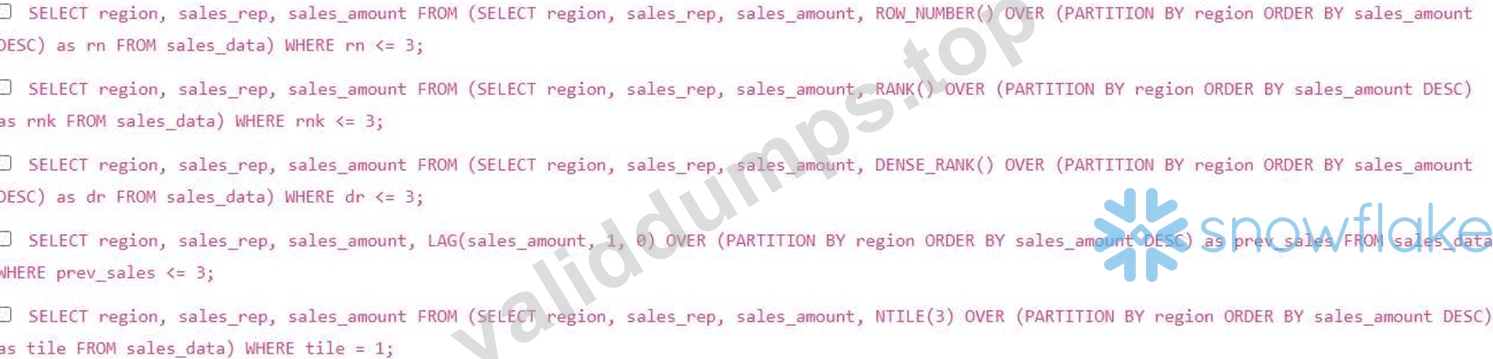
- A. Option A
- B. Option B
- C. Option D
- D. Option E
- E. Option C
Answer: A,B,E
Explanation:
Options A, B, and C correctly utilize window functions to rank sales representatives within each region. assigns a unique rank, assigns the same rank to ties and skips the subsequent ranks, and 'DENSE RANK()' assigns the same rank to ties but does not skip ranks. All three can be used with a 'WHERE clause to filter for the top 3. Option D incorrectly uses 'LAG' and doesn't achieve the desired ranking. Option E uses 'NTILE' which divides the rows into three groups; filtering 'tile = 1' might not always return the top three based on sales.
NEW QUESTION # 97
You have a Snowflake table named 'orders' with columns (INT), (DATE), and (VARIANT). The 'order_detailS column contains a JSON object with information about items in the order, including a nested array of items called 'items' , where each item has a (INT) and 'quantity' (INT). You need to write a SQL query to extract all 'product_id' values from the 'items' array within the column for orders placed in the last 30 days. Which query will accomplish this most effectively?
- A.

- B.

- C.

- D.

- E.

Answer: A
Explanation:
Option A correctly uses the 'LATERAL FLATTEN' function to unnest the 'items' array within the 'order_details variant column. This creates a row for each item in the array, allowing you to access the 'product_id' for each item. The 'WHERE clause filters the results to only include orders from the last 30 days. Options B, C, D and E do not correctly use the 'FLATTEN' function and would only retrieve the product_id of the first item in the array, if the array exists.
NEW QUESTION # 98
When performing a descriptive analysis using Snowsight dashboards, how do they assist in summarizing large data sets?
- A. Snowsight dashboards limit visualization options for large data sets.
- B. Snowsight dashboards provide visual representations aiding in quick comprehension.
- C. They offer detailed textual summaries instead of visual representations.
- D. They cannot handle large data sets efficiently for summarization.
Answer: B
Explanation:
Snowsight dashboards provide visual representations that aid in quick comprehension of large data sets during summarization.
NEW QUESTION # 99
How does leveraging Time Travel feature in Snowflake aid in query optimization and historical data analysis?
- A. Limits query execution time
- B. Offers options to alter query execution plans
- C. Enables querying of historical data versions
- D. Provides real-time data updates
Answer: C
Explanation:
Time Travel feature allows querying historical data versions, facilitating historical data analysis and retrospective query optimizations based on past data states.
NEW QUESTION # 100
You are tasked with loading data from a REST API that returns data in a deeply nested JSON format. The API requires authentication via an API key passed in the header. The JSON response contains an array of objects, each representing a customer order. You need to load only orders placed in the last 7 days. Which of the following steps and techniques would you use in Snowflake to achieve this?
- A. Create an external function to call the REST API using API Integration object, filter the orders based on the timestamp within the UDF, and return the filtered data to Snowflake to be loaded into a table. Utilize secure secrets for API Key Storage.
- B. Use a Python UDF to call the REST API, extract the relevant data, and load it into a Snowflake table.
- C. Use Snowflake's 'COPY INTO' command with a preprocessor function to transform the JSON data and filter orders placed in the last 7 days. Store the API key in the preprocessor function.
- D. Use Snowpipe with a continuous data loading pipeline, configure an external function to authenticate and load data into a temporary table then execute merge statement to apply it to the main table
- E. Create a task with 'SYSTEM$STREAM' object to extract the data from API and apply it into Snowflake tables. Use 'SECRET object to store API Key.
Answer: A
Explanation:
Option B presents the most secure and robust approach. External Functions with API Integration objects allow calling external APIs. The filtering within the UDF ensures that only the required data is loaded, optimizing performance. Secure Secrets are essential for securely storing the API key. Option A is a viable solution but it requires careful security management of the API Key within Python code. Options C is incorrect since COPY INTO command doesn't support calling API with API Key in Header and it also require preprocessor function which are hard to implement. Option D is possible but doesn't mention API keys secure store which is less secure. Option E is not possible since 'SYSTEM$STREAM' object don't allow call API for data loading.
NEW QUESTION # 101
Consider a 'customer_orders' table with 'customer_id' , 'order_date', and 'order_amount'. You need to identify customers who have placed orders consistently over the last 3 months, specifically, you need to find customers who have placed an order in each of the last 3 months (including the current month). Assume the current date is '2024-01-15'. Which of the following query snippets, when incorporated into a complete query, would be most efficient and accurate for identifying these customers?
- A.

- B.

- C.

- D.

- E.

Answer: C
Explanation:
Option E is the most precise and efficient. It explicitly checks if a customer has an order in each of the three specific months (November, December, January). It does this by truncating the 'order_date' to the beginning of the month using 'DATE TRUNC('MONTH', order_datey and then comparing against the truncated values for the last three months calculated using 'DATEADD. The 'SUM' will only be equal to 3 if the customer has at least one order in each of those months. Option A calculates the number of distinct months for each customer but doesn't guarantee they are the last 3 months. Option B checks if the customer has placed at least 3 orders in the last 3 months, but it might be that all 3 orders are in a single month. Option C doesn't count distinct months. Option D only returns 1 if the customer has placed an order in the last 3 months. It does not guarantee the customer placed an order in all the past 3 months.
NEW QUESTION # 102
You're working with a Snowflake database containing sales transaction data'. The 'SALES' table includes columns 'transaction id' , product id', 'customer id', 'transaction_date', and 'sales amount'. The Bl team needs to analyze sales trends, identify top-selling products, and segment customers based on their purchase behavior. They also need to support ad-hoc queries with various filtering and aggregation criteria'. The data volume is significant, and query performance is a key concern. Consider the following Snowflake table definition (simplified):
Which of the following SQL queries, combined with appropriate data modeling techniques, will provide the BEST performance for analyzing monthly sales trends by product category, assuming a separate 'PRODUCTS table exists with 'product_id' and 'category' columns?
- A.

- B.

- C.

- D.

- E.

Answer: D
Explanation:
Option B provides the best performance because it uses a materialized view to pre- compute the monthly sales trends by product category. Subsequent queries to the materialized view will be significantly faster than re-calculating the aggregation each time. Option A performs the join and aggregation every time the query is executed. Option C uses a correlated subquery, which is generally less performant than a join. Option D uses , which might provide the same result but doesn't address the performance issue of recalculating the aggregation every time. Option E uses a temporary table which is unncessary because a materialized view can be created directly from the SALES and PRODUCTS table.
NEW QUESTION # 103
In data modeling for BI requirements, when is it preferable to use a flattened data set instead of a data model?
- A. For complex data analysis needs
- B. For situations requiring high data normalization
- C. For scenarios necessitating extensive data transformations
- D. For quick and simple data exploration
Answer: D
Explanation:
Flattened data sets are suitable for quick and simple data exploration due to their simplified structure, facilitating easy access and analysis.
NEW QUESTION # 104
What actions are involved in performing general DML (Data Manipulation Language) operations in Snowflake? (Select all that apply)
- A. Deleting data entirely
- B. Inserting new data
- C. Merging data from multiple tables
- D. Updating existing data
Answer: A,B,D
Explanation:
General DML operations in Snowflake include inserting, updating, and deleting data.
NEW QUESTION # 105
When implementing pre-math calculations (e.g., randomization, ranking, grouping) in Snowflake, how do they contribute to data analysis?
- A. Pre-math calculations affect only specific data types
- B. Randomization techniques introduce biases in data analysis
- C. Grouping ensures data integrity and consistency
- D. Ranking aids in data summarization and ordering
Answer: D
Explanation:
Pre-math calculations like ranking assist in summarizing and ordering data, enabling meaningful insights and comparisons in data analysis.
NEW QUESTION # 106
A telecommunications company wants to segment its customers based on their usage patterns for targeted marketing campaigns. You have access to a table named 'CUSTOMER USAGE with the following columns: 'CUSTOMER ONT), 'DATA USAGE GB' (FLOAT), 'VOICE CALL MINUTES (INT), and (INT). Which of the following Snowflake features or techniques would be MOST appropriate for performing customer segmentation and determining distinct customer clusters?
- A. Creating a series of complex SQL queries with multiple 'CASE statements to manually define customer segments based on predefined thresholds for data usage, voice calls, and SMS count.
- B. Implementing a K-Means clustering algorithm using Snowflake's Python User-Defined Functions (UDFs) and storing the cluster assignments in a new column within the 'CUSTOMER USAGE table.
- C. Using the 'APPROX COUNT DISTINCT function to estimate the number of distinct usage patterns without performing actual clustering.
- D. Utilizing Snowflake's external functions to call a machine learning model hosted on a platform like AWS SageMaker or Azure Machine Learning to perform the clustering and return the segment assignments.
- E. Using Snowflake's built-in 'QUALIFY' clause combined with window functions to rank customers based on individual usage metrics and categorize them based on rank percentiles.
Answer: B,D
Explanation:
Options B and E are the most appropriate. Option B leverages Snowflake's UDF capabilities for in-database processing, allowing for potentially complex custom clustering algorithms. Option E allows integration with external machine learning platforms to take advantage of pre- built, optimized machine learning models. Option A is not appropriate because it just provides a count of distinct patterns, not the clustering itself. Option C is not scalable or maintainable for complex segmentation. Option D provides ranking, but not clustering or segmentation in the sense intended by the question.
NEW QUESTION # 107
......
A fully updated 2025 DAA-C01 Exam Dumps exam guide from training expert ValidDumps: https://examboost.validdumps.top/DAA-C01-exam-torrent.html