


HFDP Exam PDF [2025] Tests Free Updated Today with Correct 116 Questions
ASHRAE HFDP Exam Preparation Guide and PDF Download
NEW QUESTION # 43
After coming into direct contact with medical instruments in a sterilizer, where should clean steam condensate that has been tempered be directed to?
- A. Steam system deaerator
- B. Sterilizer make-up
- C. Clean steam generator
- D. Waste drain system
Answer: D
NEW QUESTION # 44
Secondary (redundant) air systems for maintenance purposes are MOST often used in which of the following locations?
- A. Bone Marrow Transplant Units
- B. Radiation Treatment Rooms
- C. Procedure Room
- D. Intensive Care Units
Answer: A
NEW QUESTION # 45
An Airborne Infection Isolation Room is 10 ft. × 12 ft. (3.05 m × 3.66 m) and has an 8 ft. (2.44 m) ceiling. An adjoining anteroom measures 6 ft. × 8 ft. (1.83 m × 2.44 m) with a 7.5 ft. (2.29 m) ceiling height. Airflow measurements reveal: Room supply diffuser: 135 CFM (64 L/s), Exhaust register: 200 CFM (95 L/s), Anteroom supply diffuser: 100 CFM (48 L/s), Anteroom exhaust register: 65 CFM (31 L/s). Which of the following represents the correct patient room air change rate (ACH)?
- A. 14.3 ACH
- B. 13.6 ACH
- C. 12.5 ACH
- D. 15.6 ACH
Answer: C
Explanation:
Comprehensive and Detailed Explanation:
Room Volume: 10 × 12 × 8 = 960 ft³.
ACH Calculation: ACH = (Airflow in CFM × 60) / Room Volume. For AIIRs, ASHRAE 170 uses exhaust airflow (200 CFM) since it determines air changes: ACH = (200 × 60) / 960 = 12,000 / 960 = 12.5 ACH.
Verification: Supply (135 CFM) < Exhaust (200 CFM) ensures negative pressure, consistent with AIIR requirements (12 ACH minimum, Table 7.1).
NEW QUESTION # 46
Which of the following is the BEST location for a room thermostat in a typical patient room?
- A. Near the window
- B. Below the supply air register
- C. Near the ceiling
- D. Below the return air register
Answer: D
NEW QUESTION # 47
The significance of skin squames to healthcare HVAC&R design is that skin squames are associated with:
- A. Interference with the proper operation of fluoroscopy units
- B. Excessive loading of filtration systems
- C. Compromised efficiency of ultraviolet germicidal irradiation in sealed rooms
- D. Contamination of sterile fields in operating rooms
Answer: D
NEW QUESTION # 48
Which of the following is a quench duct associated with?
- A. MRI Room
- B. Medical Gas Storage Room
- C. Emergency Generator Room
- D. Operating Room
Answer: A
NEW QUESTION # 49
A Protective Isolation Room, Surgical Cystoscopic Room, or Bronchoscopy Room shall maintain a MINIMUM room differential pressure of:
- A. 0.01 inch water gauge (2.5 pascals)
- B. 0.10 inch water gauge (25 pascals)
- C. 0.05 inch water gauge (12.5 pascals)
- D. 0.025 inch water gauge (7.5 pascals)
Answer: A
NEW QUESTION # 50
Air in an Airborne Infection Isolation Room shall be:
- A. Re-circulated within the room
- B. Directed outside
- C. Transferred to an adjacent room
- D. Returned to the main air handling system
Answer: B
Explanation:
Comprehensive and Detailed Explanation:
AIIR Exhaust: ASHRAE 170, Section 7.2.1, requires air from AIIRs to be exhausted directly outside (or HEPA-filtered if recirculated) to prevent pathogen spread. Recirculation (A), transfer (B), or return to AHU (D) are prohibited without filtration.
NEW QUESTION # 51
A hospital has made a decision to change the type of surgeries that are being performed in one of its Class B Operating Rooms. The changes will require the room to be a Class C room. According to the HVAC Design Manual for Hospitals and Clinics, which of the following BEST describes the changes that should be made to the ventilation system?
- A. Increase ACH to 25
- B. Maintain current ventilation rate
- C. Decrease air flow to maintain ACH
- D. Relocate return air diffusers to the ceiling
Answer: A
Explanation:
Comprehensive and Detailed Explanation:
Class B vs. Class C: ASHRAE 170 and FGI Guidelines define Class B ORs (minor procedures) at 15 ACH minimum, and Class C ORs (major surgeries) at 20-25 ACH minimum (Table 7.1). The HVAC Design Manual recommends 25 ACH for Class C to ensure sterile conditions.
Option Analysis:
A: Incorrect-Class C requires higher ACH.
B: Incorrect-Decreasing airflow reduces ACH.
C: Incorrect-Return grilles stay low, not ceiling.
D: Correct-25 ACH aligns with Class C needs.
NEW QUESTION # 52
An Operating Room ventilation system must monitor and automatically:
- A. Alarm when waste anesthetic gas levels are elevated
- B. Prevent recirculation of smoke within the surgical suite
- C. Set back the ventilation system when the surgical suite is not in use
- D. Control the dew point within the room
Answer: A
NEW QUESTION # 53
The isolation room is supplied with 300 cfm (142 L/s) of HEPA filtered air. The return air grille is located in the ceiling and has been balanced to 150 cfm (71 L/s). The room is monitored with a differential pressure sensor, and the sensor is sending an alarm signal to the nurse's station. Which of the following BEST describes the problem?
- A. This is an Airborne Infection Isolation Room with inadequate toilet room exhaust of 25 cfm (12 L/s)
- B. This is a Protective Environment Room with inadequate toilet room exhaust of 25 cfm (12 L/s)
- C. This is a Protective Environment Room with the door to the corridor propped open
- D. This is an Airborne Infection Isolation Room with the door to the corridor propped open
Answer: A
Explanation:
Comprehensive and Detailed Explanation:
Airflow Analysis: Supply = 300 cfm, Return = 150 cfm, Toilet Exhaust = 25 cfm. Total exhaust = 150 + 25 =
175 cfm. Net airflow = 300 - 175 = +125 cfm (positive pressure).
AIIR Requirements: ASHRAE Standard 170, Section 7.2.1, mandates negative pressure for Airborne Infection Isolation Rooms (AIIRs), meaning exhaust must exceed supply. Here, the room is positive (+125 cfm), triggering the pressure sensor alarm.
Problem Identification: The toilet exhaust (25 cfm) is insufficient to offset the supply, failing to achieve negative pressure. AIIRs typically require 50-75 cfm exhaust per toilet (Table 7.1), so 25 cfm is inadequate.
Option Analysis:
A: Correct-insufficient exhaust explains the positive pressure in an AIIR.
B: An open door would reduce pressure differential but not explain the airflow imbalance.
C/D: Protective Environment (PE) rooms require positive pressure, which aligns with the +125 cfm, but the alarm suggests an AIIR (negative pressure) context.
NEW QUESTION # 54
Which of the following types of sterilizers requires an exhaust grille?
- A. Glass bead
- B. Ethylene oxide
- C. Gamma radiation
- D. Ultrasonic
Answer: B
NEW QUESTION # 55
In addition to nutrients and a favorable temperature, which of the following do disease organisms require for optimal growth?
- A. Light
- B. Host body
- C. Moisture
- D. Air
Answer: C
NEW QUESTION # 56
Which of the following control methods offers the MOST building information versatility in controls and building management?
- A. Direct digital control
- B. Electric control systems
- C. Pneumatic controls
- D. Electronic control systems
Answer: A
NEW QUESTION # 57
Which of the following is a key role of the HVAC system designer during the Infection Control Risk Assessment process?
- A. Serve as a resource to the multidisciplinary team
- B. Locate the mechanical spaces within the building
- C. Supply air quality data to assess filtration needs
- D. Prepare test and balance reports
Answer: C
NEW QUESTION # 58
Which of the following ventilation system criteria is the MINIMUM for a room housing a patient who has a compromised immune system?
- A. 12 ACH, airflow direction towards the patient
- B. 15 ACH, airflow direction towards the patient
- C. 15 ACH, airflow direction away from patient
- D. 12 ACH, airflow direction away from patient
Answer: A
Explanation:
Comprehensive and Detailed Explanation:
Protective Environment (PE) Room: Designed for immunocompromised patients (e.g., transplant recipients), ASHRAE Standard 170, Section 7.2.2, requires 12 ACH minimum and positive pressure (airflow towards the patient) to protect against external contaminants.
Option Analysis:
A/C: Airflow away from the patient (negative pressure) is for AIIRs, not PE rooms.
B: Correct-12 ACH with positive pressure meets the minimum for a PE room.
D: 15 ACH exceeds the minimum requirement.
NEW QUESTION # 59
A decontamination area that requires 6 ACH and has a volume of 10 ft. x 10 ft. x 8 ft. (3.05 m x 3.05 m x 2.44 m) requires a MINIMUM of how many exhaust cfm (L/s)?
- A. 480 cfm (227 L/s)
- B. 600 cfm (284 L/s)
- C. 80 cfm (38 L/s)
- D. 130 cfm (62 L/s)
Answer: C
Explanation:
To determine the minimum required exhaustCFM (cubic feet per minute)for the decontamination area, we use the formula: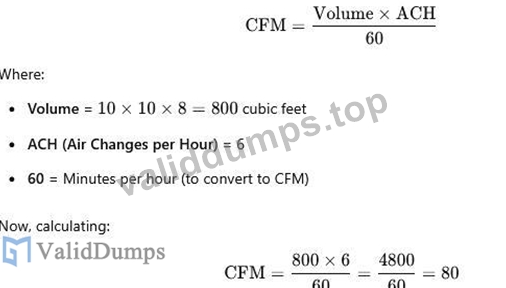
NEW QUESTION # 60
Which of the following HVAC systems is prohibited in Operating Rooms and Critical Care Areas?
- A. Radiators or convectors
- B. Variable volume with reheat coils
- C. Smooth radiant cooling and heating panels
- D. Constant volume with reheat coils
Answer: B
Explanation:
Comprehensive and Detailed Explanation:
ASHRAE 170 Restriction: Section 6.3 prohibits Variable Air Volume (VAV) systems in ORs and critical care areas due to potential airflow fluctuations disrupting pressure and sterility. Constant volume (A) is required, while radiators (C) are discouraged due to dust accumulation. Radiant panels (B) are allowed if smooth.
NEW QUESTION # 61
Which of the following departments typically maintains its own sterile processing area for diagnostic equipment?
- A. Ultrasound
- B. Endoscopy
- C. Microbiology
- D. Echocardiography
Answer: B
NEW QUESTION # 62
Which of the following is the recommended location for Group E (non-aspirating) air diffusers in Operating Rooms?
- A. In the center of the ceiling over the surgical table
- B. In the substerile ceiling
- C. High on the sidewall on at least two opposite walls
- D. On the perimeter of the room outside of the lights
Answer: A
Explanation:
Comprehensive and Detailed Explanation:
Group E Diffusers: These non-aspirating diffusers provide laminar, downward airflow. ASHRAE Standard
170 and FGI Guidelines recommend placement in the ceiling center, directly above the surgical table, to ensure clean air blankets the sterile field.
Option Analysis:
A: Correct-center ceiling placement is standard for ORs.
B/C: Sidewall or perimeter placement disrupts laminar flow.
D: Substerile areas are adjacent, not the OR itself.
NEW QUESTION # 63
In accordance with the most current edition of NFPA 101, which of the following must be true of windows in patient rooms?
- A. Windows are for the use of patients to provide natural ventilation
- B. Windows shall be operable by the use of a tool or key
- C. Windows are optional
- D. Windows can be of fixed type or sealed
Answer: D
NEW QUESTION # 64
Which of the following statements is true about the FGI Guidelines for the Design and Construction of Health Care Facilities?
- A. It is a set of minimum recommended guidelines for adoption by regulatory agencies
- B. It is a required set of minimum guidelines for compliance with the Uniform Building Code
- C. It is a set of minimum guidelines adopted by the American College of Surgeons for the design of operating rooms
- D. It is a federally mandated set of minimum guidelines for compliance with the Centers for Medicare and Medicaid Services
Answer: A
NEW QUESTION # 65
......
Verified & Correct HFDP Practice Test Reliable Source Nov 05, 2025 Updated: https://examboost.validdumps.top/HFDP-exam-torrent.html